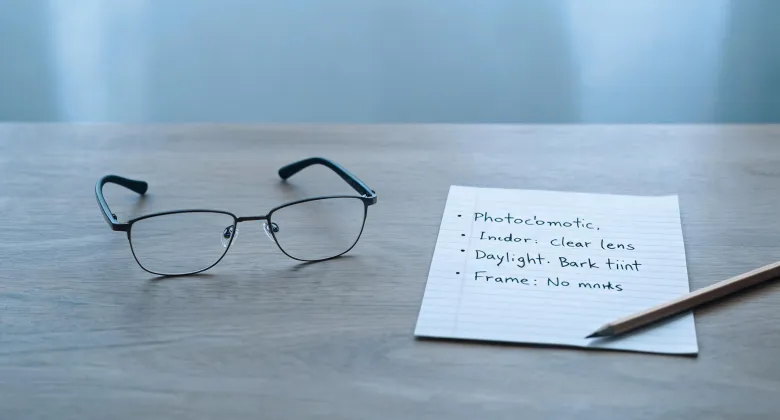
If you've got 30 seconds, here's the punchline: your first filter for any photochromic glasses supplier should be lens temperature-response data, not price or lead time. The most common B2B failure modes for photochromic lenses — inconsistent fade speed, UV transmittance that doesn't match the label, edge distortion on non-prescription lenses — are basically invisible at delivery. They show up two weeks later, on your customer's face. And the root cause is almost always the same: the lens spec wasn't specific enough to catch anything.
That took me $47,000 and eight years to really internalize.
Where those numbers come from
I've been handling B2B and OEM orders in photochromic eyewear for eight years now — cycling lenses, rimless photochromic glasses, non-prescription pairs, and loose lens supply. In that time I've audited around 60 suppliers, placed somewhere north of 340 orders, and made nine mistakes I bothered to write down. I documented them because I have a terrible memory and I don't intend to pay the same tuition twice.
My first big lesson was in 2017 — an 800-pair order of rimless photochromic glasses. Sample passed, spec sheet looked clean, then the container arrived. That's where I learned that "looks fine on paper" and "is actually fine" are separated by real money.
Five specific mistakes that cost me
The fade-speed average trap (2018)
It took me about two years and 140 orders to fully believe this: two suppliers can both say "fast fade" and differ by a factor of three. On a 500-pair cycling photochromic glasses order, the supplier promised 15–30 seconds. The samples did indeed fade in 22 seconds — inside a 22°C air-conditioned office. The production run arrived in December and sat in an unheated warehouse. By the time lenses reached customers, fade times ranged from 8 seconds to 90 seconds.
Fade-speed variance matters more than average fade speed. Sounds obvious now. It wasn't when I signed the PO without writing temperature performance into the contract. About 120 of the 500 pairs ended up sold at a discount. Profit hit: roughly $2,800, not counting the follow-up emails.
Every spec sheet I write now includes: "Fade speed must stay under 25 seconds at both 0–5°C and 25°C." Just that line filters out half the suppliers who only know how to say "our lenses are fast."
The rimless hinge disaster (2019)
Rimless photochromic glasses look structurally simple — lens, frame, hinge. But in a rimless build, the lens is a load-bearing component. On a 600-pair order, I approved a new hinge design because the supplier said it had passed "10,000-cycle open-close testing." What they omitted: they'd tested that hinge on a full-frame build, not a rimless one, where the lens takes significantly more stress around the screw holes.
We didn't hear about the failures until two weeks post-deployment. Roughly 40 pairs had micro-cracks radiating from the lens mounting points. Rework cost $5,200 plus air-freight replacement — call it $6,100 all-in. That was the first time I genuinely understood that a test report only proves what was tested, and what was tested may not match your actual product structure.
The new-vs-established supplier decision (2021)
In early 2021 I found myself going back and forth for two full weeks between an incumbent cycling photochromic glasses supplier and a new one. The incumbent: $38/pair, 45-day lead, three years of history, 5% batch inspection with full reports. The new option: $29/pair, 30-day lead, custom frame colors available. On paper the new one was better on every line item. I still chose the incumbent — because I already knew their QC process, and I'd been burned twice before by suppliers who looked better on paper.
Is that conservative? Yeah, probably. But the lowest quoted price is very rarely the lowest total cost. That said, I won't pretend I slept well those two weeks. If a decision keeps you up at night, the checklist you're using probably isn't detailed enough yet — go add the missing criteria before you sign.
The accidental blind-test finding (2022)
Honestly, this one surprised me. I'd assumed that more expensive suppliers always had better optical uniformity on non-prescription photochromic glasses. In 2022 we ran an informal blind test — three suppliers, same prescription benchmark, seven team members judging edge distortion and clarity. A mid-priced supplier scored highest on edge-distortion control. The two suppliers quoting ~30% more didn't win.
I'm not saying expensive is bad. I'm saying price and optical quality aren't linearly related, especially in the non-prescription tier, where substrate and coating process matter far more than brand markup. Never expected that. Turns out "premium" is sometimes just a label someone put on a purchase order.
The spec-sheet recurring frustration
The most frustrating part of this whole job: you write a spec, the supplier confirms the spec, and then the shipment still doesn't match the spec. "UV400" is a good example — nearly every supplier prints it, but actual UV transmittance curves vary a lot in practice. We now require spectrophotometer data per batch, not just the label. A label proves nothing; data does.
Across the last 18 months, our team has flagged 47 potential problems using this checklist. Around 12 of those — my rough estimate — would have turned into disputes or rework.
When this checklist doesn't apply
I want to be honest about the boundaries here. This whole "write detailed lens specs, demand test data" approach fits standardized B2B sourcing: established frame styles, clear specs, bulk quantities, repeat orders. If you're doing heavy customization — oddly curved cycling lenses, complex coatings on rimless builds — the supplier's engineering capability and how well they communicate during development matters more than any pre-built checklist.
Also, if your order quantity is small (say under 50 pairs), pushing for full test reports is often unrealistic. In that range, sample verification plus batch-level inspection is more practical than paperwork.
And one last thing — I don't always follow my own process. Last year I skipped a lens spot-check to hit a delivery deadline. Got 30 cycling photochromic lenses with fade-uniformity issues. So the value of this checklist isn't in executing it perfectly. It's in having something that catches you before the mistake compounds — even when you sometimes walk right past it.