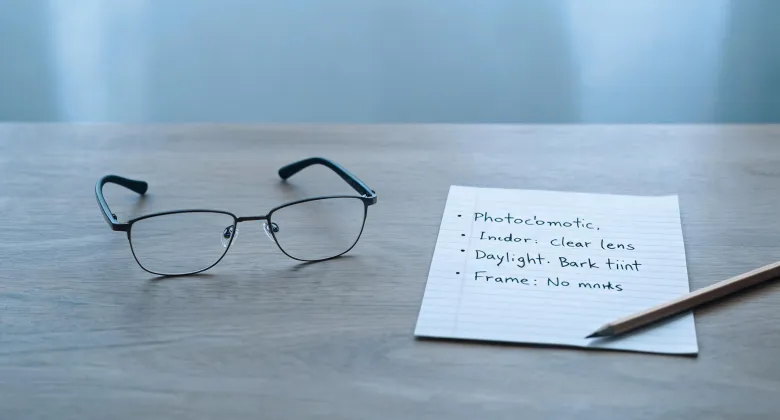
The Order That Looked Fine on Paper
In Q1 2024, I handled photochromic glasses sourcing for our field crew—about 40 pairs for surveyors and site managers who spend most of the day outdoors. I pulled three quotes, compared unit prices, and picked the middle one. The supplier had a clean-looking spec sheet, promised a two-week lead time, and the price seemed reasonable (roughly $30–35 per pair, if I remember correctly).
I felt pretty good about it. Six weeks later, I'm getting calls from two supervisors asking why half the crew has stopped wearing their glasses.
Honestly, I thought sourcing photochromic glasses was basically a price comparison exercise. It's not. The price is the easy part. The hard part is understanding what "photochromic" actually means on that spec sheet.
The Real Problem: "Photochromic" Is a Category, Not a Specification
Here's the thing I didn't understand until I'd spent maybe 18 months and a ton of back-and-forth with suppliers: photochromic glasses lenses vary enormously in performance. Two lenses can both be labeled "photochromic" and behave completely differently outdoors.
The spec sheet won't always tell you:
- Activation time—how fast the lens darkens when you step outside. Some take under 30 seconds; others take a couple of minutes.
- Fade time—how fast they clear up again. This matters more than people think, especially for crew members moving in and out of vehicles all day.
- Darkness range—how dark do they actually get? A lens that tops out at 50% tint is a different product from one hitting 80%.
- Temperature sensitivity—photochromic performance drops in high heat. If your crew works in summer sun, that's worth checking.
Per ANSI Z80.3, the U.S. standard covering non-prescription sunglasses and fashion eyewear, photochromic lenses are classified by their light transmittance ranges. But the supplier's marketing sheet often skips those numbers entirely. One vendor sent me a spec sheet that literally said "photochromic lenses—high quality." That was it. No transmittance data, no activation rating. (Note to self: ask for test documentation before the quote, not after.)
The Non-Prescription Trap
We ordered non prescription photochromic glasses, which I assumed would simplify things. In some ways it does—no prescription verification, no lab work. But "non-prescription" doesn't mean "one-size-fits-all."
When I compared the $22 pair against the $35 pair side by side—same supplier, same order—I finally understood why the cheaper ones never got worn: the frame was flimsier, the lens edge had visible distortion, and the temporal coverage was too narrow for anyone with a wider face. The cheap pair wasn't a bargain. It was a false economy.
Then there was the terminology problem. I said "photochromic." One vendor heard "tinted." We went back and forth about UV protection for two emails before I realized they were quoting me standard polarized sunglasses with a light tint. They weren't trying to mislead anyone—they genuinely used different vocabulary for the same category. We both said "photochromic" but meant different things. Classic.
Cycling Photochromic Glasses Are Their Own Beast
About a third of our team also uses the glasses for cycling—commuting and weekend rides. I didn't think much about it until one of the riders told me the glasses made him dizzy on descents.
Turns out, cycling photochromic glasses need things that standard safety glasses don't:
- Optical clarity across a wide field of view—any edge distortion shows up worse when you're moving fast.
- Ventilation—without it, lenses fog up the moment you stop pedaling.
- Wrap and coverage—the eye needs protection from wind and debris at speed, not just sunlight.
I should have known this. But my background is procurement, not optometry. The vendor didn't ask how the glasses would be used, and I didn't tell them. We both assumed the other side knew. That's not a vendor problem—that's a sourcing process problem.
What It Actually Cost
Let me put real numbers on this, because I think that's the part that finally got my VP's attention:
40 pairs at roughly $32 average comes to about $1,280. Of those, maybe 18–20 pairs went essentially unworn. So call it $600 in wasted product. That's not huge in the scheme of an annual budget. But then you add:
- My time re-sourcing (roughly 6–8 hours over two weeks)
- Two supervisors chasing me about it
- A second order at a higher unit price because I needed faster delivery
- The intangible cost of looking like I didn't know what I was buying
If I'd spent 45 minutes upfront checking lens specs and ordering two sample pairs, I would have avoided most of this. That's the math that stuck with me.
The Four Checks I Run Before Any Order
Now I don't place a photochromic glasses order without these:
- Request the transmittance data in writing. Ask for the lens category (1–4 under EN ISO 12312-1) and activation/fade times. If the supplier can't provide them, that tells you something.
- Order samples—at least two sizes. Wear them outside for an hour. Check edge distortion by looking at a straight line—a door frame or road marking—and turning your head slowly.
- Confirm the use case explicitly. "Cycling" and "general outdoor" are different specs. Put it in the email chain so there's a paper trail.
- Verify UV claims against a standard. ANSI Z80.3 or EN ISO 12312-1 for sunglass-level UV protection; ANSI Z87.1 if the glasses double as safety eyewear. Don't rely on "UV400" branding alone—ask for test documentation.
Prices and standards cited above are current as of early 2025; verify current requirements at ANSI.org or your relevant standards body before ordering.
None of this is complicated. It's just a checklist. But the 12-point checklist I built after this mess has saved us at least one reorder—probably more—in the year since. Five minutes of verification beats five days of correction.
Bottom line: photochromic glasses sourcing isn't hard because of the product. It's hard because the spec sheet doesn't tell you what you actually need to know—and nobody flags that until the wrong order shows up.