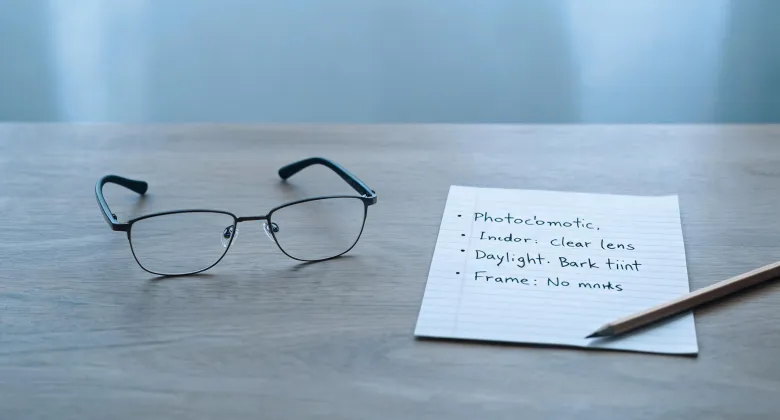
I review photochromic eyewear deliveries before they go out to our distributors—roughly 40 SKUs a quarter, or about 160 a year. In six years of that, I've rejected around 12% of first batches. Almost none of those rejections were because the factory was fundamentally bad. They were because the buyer compared the wrong things.
Here's the comparison I actually use. It's not photochromic glasses versus some other product category. It's standard, catalog-style photochromic sourcing versus use-specific sourcing—the kind you do when the SKU is built around a defined channel: cycling, rimless frames, non-prescription retail. Same base lens chemistry. Completely different failure modes. That difference decides whether your first shipment clears inspection or bounces back.
Three dimensions matter most: lens activation and recovery speed, rimless mounting behavior, and non-prescription SKU consistency. I'll compare each one directly, then give you the call I'd make in each scenario.
Dimension 1: Activation speed — general-purpose vs. cycling photochromic glasses
This is where most sourcing mistakes start.
General-purpose photochromic lenses are specced around ambient light change, not motion and safety. When you source cycling photochromic glasses, the spec that matters isn't "does it darken"—it's how fast it recovers when you come out of a tunnel or a shaded descent.
Here's the technical anchor. EN ISO 12312-1 classifies lens transmittance from Category 0 to Category 4. A typical photochromic lens swings between roughly Category 1 (80–43% visible light transmission) and Category 3 (18–8% VLT). The darkening half is usually acceptable across suppliers. The recovery half—going from dark back to light—is the slow side, and on a bicycle that slow side is a safety issue. ISO 8980-3 sets the underlying transmittance test method, but it doesn't tell you whether a lens is fast enough for a rider entering a lit road from tree cover. That part is on you as the buyer.
I tested this directly in 2024. We pulled five cycling SKUs from three suppliers and measured recovery time at 20°C and at 35°C. Recovery at 35°C was roughly 40% slower on two of the three suppliers. Hot days are exactly when cyclists are out. That's the detail a catalog photo doesn't show you.
Comparison conclusion: For general retail, activation speed is enough. For cycling photochromic glasses, recovery speed is the buying spec, and you should write the temperature condition into the purchase order—not just "photochromic," but the recovery window at 35°C.
A small counterintuitive point: price didn't predict recovery speed in our test. The most expensive lens finished third. The middle-priced one was fastest. Sourcing cycling photochromic glasses on price-per-unit alone gets you a slow lens with a nice coating.
Dimension 2: Rimless mounting — full-frame vs. rimless photochromic glasses
Free advice: rimless and photochromic are not a simple combination. They're two different manufacturing tolerances meeting at the same lens.
Full-frame photochromic glasses hide edge issues. The frame covers the lens perimeter, so a slightly uneven coating edge or a 0.2–0.3 mm thickness variation disappears behind the rim. Your inspection passes because there's nothing visible to fail.
Rimless photochromic glasses have no cover. The lens edge is the product. Drill holes, edge polish, and tint uniformity at the edge are visible every time someone looks at the frame. And in most supply chains the photochromic coating is applied before the edge work, which means drilling or re-edging after coating can leave a visible clear halo around the mounting hole.
The batch that changed my spec sheet came in March 2023: 600 rimless photochromic lenses, 14 of them shipped with hairline crazing radiating from the drill holes. The supplier called it "within industry standard." Our spec didn't cover drill-hole edge integrity, so technically they weren't wrong. We ate the rework and rewrote the PO template to include a drill-edge inspection under 10x magnification.
That was also a real decision, not a hindsight story. The upside of that supplier was about 18% lower unit cost. The risk was edge quality we couldn't see until after coating. We took the switch. March 2023 is what that decision felt like on the receiving dock.
Rimless isn't a frame choice. It's a lens requirement.
Comparison conclusion: Full-frame lets you source on lens performance alone. Rimless makes the lens edge a first-class spec item. If you're sourcing rimless photochromic glasses, add edge-chipping, drill-hole crazing, and coating-to-edge transition to the inspection protocol—or budget for a reject rate you didn't plan on.
Dimension 3: Non-prescription SKU consistency — the efficiency win with a hidden cost
This is the one where the process-efficiency argument actually holds up.
Prescription photochromic glasses are one-to-one. Every order is a lab job, and your sourcing process is built around individual verification. Non-prescription photochromic glasses are one-to-many: you're buying a batch of identical SKUs, and the whole process can run on batch sampling instead of unit inspection.
That's a real efficiency gain, not a slogan. When we moved our non-prescription photochromic SKUs from 100% visual inspection to AQL 2.5 sampling with a documented tester protocol, turnaround on incoming inspection dropped from five days to two. Not because the lenses got better. Because the process stopped inspecting units one at a time.
But here's the catch, and it's why I don't tell people non-prescription sourcing is "easier." Batch consistency is harder to verify than individual quality. If one lens in a batch of 2,000 is off-spec, sampling may miss it—and at scale, one bad lens becomes 500 customer complaints. With prescription work, the bad lens gets caught at the lab bench. With non-prescription sourcing, it gets caught by your customer.
Comparison conclusion: Non-prescription sourcing wins on process speed and loses on batch consistency risk. Prescription sourcing is slower and individualized but has built-in per-unit verification. Don't switch to non-prescription SKUs expecting a simpler quality job—expect a different one.
Which sourcing path fits your program
So here's how I'd actually decide, by scenario:
- Retail or distribution, standard catalog SKU: General-purpose photochromic glasses, non-prescription, batch-sampled. Put your effort into a written batch-consistency test—tint uniformity across the batch, not per-lens perfection.
- Cycling or sport brand: Source cycling photochromic glasses against a recovery-speed spec at high temperature. Test the tunnel scenario before you sign. Ask for the recovery curve, not just the VLT range.
- Premium or fashion rimless line: Source rimless photochromic glasses only after a pre-production drill-edge sample. If the supplier won't do one, that's your answer.
- Mixed catalog: Keep non-prescription SKUs and rimless SKUs on separate inspection protocols. One process can't cover both failure modes.
It took me about four years and a few hundred rejected lenses to understand that sourcing photochromic glasses is really three sourcing jobs wearing one product name. General, cycling, rimless, non-prescription—they share a lens technology, not a spec sheet. If you compare them like they're the same purchase, you'll get a batch that passes one test and fails the one that matters for your channel.
One last thing I'd add to any PO: write the failure mode into the spec. Don't say "high-quality photochromic lens." Say "recovery to Category 2 within X seconds at 35°C" or "no crazing at drill holes under 10x." The supplier can only meet a spec you can measure. That's the whole game.