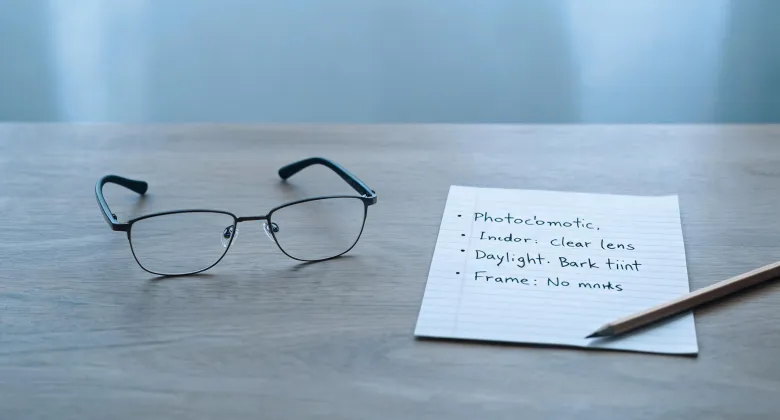
The Complaint I Hear Most
If I had to pick the single most common complaint from buyers sourcing photochromic glasses, it's this: "The sample was perfect. The bulk order wasn't."
Rimless photochromic glasses that looked elegant in the sample arrive with uneven lens edges. Photochromic glasses cycling models that transitioned in 30 seconds at the sample stage take 50 in production. Non prescription photochromic glasses that faded to near-clear now leave a faint tint behind.
The instinct is to blame the supplier. Switch factories. Demand a redo. And sometimes that's justified.
But after reviewing 300+ production batches since 2021, I've come to a less comfortable conclusion. Most of the time, the problem wasn't the supplier. The problem was that we never actually defined what "correct" meant in a way that could be measured.
"Sample-Approved" Is Not a Specification
A sample is a reference point. It's not a spec.
When I approve a sample, I look at it, put it on, take it outside, watch it change. I make a judgment call. That judgment feels rigorous. It isn't. It's a vibe.
The supplier sends a batch and says "within tolerance." The question is: whose tolerance? The photochromic glasses lenses industry doesn't have a single universal standard for transition speed, fade-back time, or color depth consistency. There are broad parameters, sure, but "photochromic" covers a wide range of performance. A lens that changes in 40 seconds and one that changes in 15 seconds can both legitimately be called photochromic.
What I didn't understand until later—and this is the part that stung—is that the gap between my sample and my production batch was often a gap between two different assumptions about what matters.
In early 2023, I ran a comparison. Same supplier, same model number, two orders placed three months apart. Order A was for our cycling line. Order B was for a rimless fashion line. Both used photochromic lenses. Side by side, the cycling lenses darkened faster but plateaued at a lighter shade. The rimless lenses went darker but were slower to activate.
The supplier hadn't changed anything. We had. The cycling order specified a thinner lens profile for weight reduction. That's it. That's all it took. A lens profile spec, added by our own product team, shifted the photochromic performance because the lens needed to be treated differently to accommodate the thickness.
Nobody flagged it. Because nobody had written down "transition speed must remain within ±15% of approved sample" in the purchase order.
The Part Nobody Warns You About: Temperature
Here's something I wish I'd learned earlier. Photochromic lens performance is temperature-sensitive. A lens that darkens beautifully at 25°C may underperform at 5°C. It's chemistry—the color-changing molecules in the lens respond to UV exposure, but the tinting depth depends partly on ambient temperature. Cold weather slows the activation; heat accelerates fade-back.
When I approved the sample in our office in autumn, I was testing under conditions that didn't match where the cycling glasses would actually be used. A winter rider at 7 a.m. in 4°C weather is a different test environment than a comfortable conference room in October.
Nobody in our chain—not our supplier, not our internal spec—flagged that the sample approval environment wasn't representative of the end-use environment. The supplier tested to a standard that worked for them. We approved based on a sample that worked for us. Both were true. Both were wrong.
What This Has Actually Cost
In Q2 2023, we rejected a batch of 1,200 non prescription photochromic glasses because the fade-back time was inconsistent across the lot. Some lenses cleared in 2 minutes. Others stayed tinted for 6-plus minutes. For a product sold to outdoor enthusiasts who take their glasses on and off in changing light, that inconsistency is a functional failure, not a cosmetic one.
The redo cost us about $4,800 and pushed our launch by three weeks. But the bigger number was the wholesale accounts that had to be rescheduled, the marketing spend that got burned on a launch that didn't happen on time, and the trust we had to rebuild with two retail partners who'd been told—by us—that delivery was certain.
We didn't have a formal incoming inspection protocol for photochromic performance. We had a general QC checklist—scratches, frame alignment, hinge tension—but nothing that specifically measured transition behavior under controlled conditions. The third time this happened, I built the protocol. Should have done it after the first.
What Actually Worked (Briefly)
The fix wasn't a new supplier. It wasn't a lower price. It was a different way of specifying.
We now write photochromic performance into the purchase order as measurable parameters: transition time range, fade-back maximum, residual tint limit, and—critically—the temperature conditions under which those measurements must be verified. We test incoming batches against those specs, not against "does it look like the sample."
And we pay for certainty. When we need a batch for a cycling season launch with a hard deadline, we now choose the supplier who quotes a firm delivery date with a defined quality protocol over the one who quotes 15% less and says "usually on time."
The premium isn't just about speed. It's about knowing what you're getting and when. The cheap option that arrives late, or arrives on time but fails inspection, is never actually cheaper.
If you're sourcing photochromic glasses—rimless photochromic glasses, photochromic glasses cycling, non prescription photochromic glasses, whatever the category—the first question isn't "who has the lowest price?" It's "can both sides agree on what 'correct' means, in numbers, before the PO is signed?"
If the answer is no, the sample doesn't matter. The batch will surprise you. And it won't be a pleasant one.