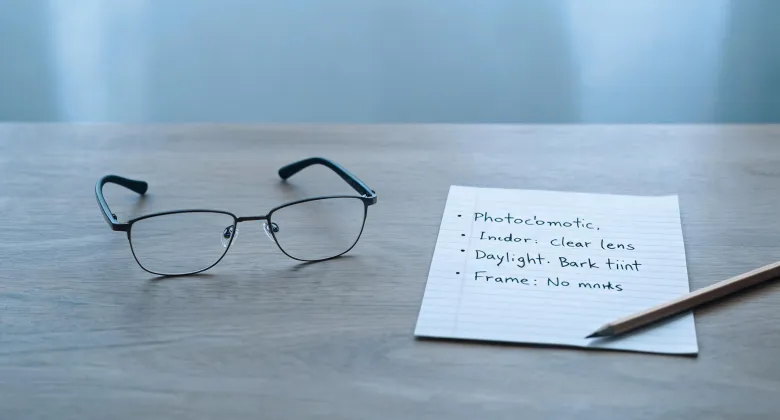
The Request That Looked Easy
In March 2024, our VP of Operations walked over to my desk and asked if I could handle eyewear for the new employee bike-commute program. Forty sign-ups at that point, maybe a few more by launch. Budget approved, fairly modest.
I'd taken over purchasing in 2020. By then I'd sourced branded swag, safety gear, conference materials, and roughly 60-80 orders a year across eight vendors. So my initial read on this was: sunglasses, bulk order, done in a week.
That read was wrong in about four different ways.
'Any Dark Lens Works' — And Other Things I Got Wrong
My first assumption was that dark lenses were dark lenses. I ran quotes in three places I knew of (this was back in March 2024), and the lowest was around $18 a pair from a regional sporting goods vendor. I was two emails from cutting the PO.
Then the commute group asked for a call with me. Thirty people joined.
Their first point: tinted sunglasses are fine on an open road, but most of this group rides shared paths with tree cover, and they were finishing their rides around 4:30-5pm in shoulder season. One rider said it plainly — going from bright pavement into shade, you can't adjust fast enough, and you're now riding blind for two or three seconds.
Their second point: about a third of the group wears prescription glasses. They wanted to stop stacking sunglasses over them, or taking them off mid-ride.
Their third point, and the one that reframed the whole project: they specifically wanted photochromic lenses. Frameless, if possible.
What I Didn't Know About Photochromic Lenses
I thought 'photochromic' meant 'sunglasses that go clear indoors.' That's roughly correct, but it turned out to be the least useful thing to know for a purchasing decision.
Here's what actually mattered: photochromic lenses activate on UV exposure, not visible light. That single fact explains almost everything about where they work well and where they don't.
For cyclists, it works in their favor. Riders face upward, catch a lot of UV, and the lenses darken and lighten roughly in step with the light around them. One commuter told me that on morning rides starting around 6:20am in October, the lenses stayed clear until the sun actually came up. That's the behavior they wanted.
For anyone driving, it's the opposite. Most car windshields block the vast majority of UV, so photochromic lenses won't darken much behind the wheel. Nobody warned me about this. I had to find it out myself before I could explain to my VP why we weren't also issuing these to the people who drive to work.
Once I understood the activation mechanism, I stopped shopping for 'glasses' and started shopping for a performance spec.
The Invoice That Cost Us $1,890
Then I made my expensive mistake.
In April 2024, I found a new supplier. Clean web catalog, fast replies, 32% cheaper than anything else I'd quoted. Forty-seven pairs of photochromic sport frames, $1,410 total. I placed the order.
Most of the shipment was fine. The paperwork was not. What I received was a scanned handwritten receipt with a stamp I couldn't identify — no tax ID, no itemized invoice.
Finance rejected the expense report outright. Not delayed. Rejected. Because we had no clean documentation, the $1,410 came out of our department budget.
On top of that, six pairs arrived with scratched lenses and had to be replaced. The replacements cost $480 because the original supplier had gone quiet.
So: $1,890 for a shipment that was quoted at $1,410.
Now I verify invoicing capability before I place any order — in the first outreach email, not after delivery. It sounds like a small procedural thing. It's the single most expensive lesson I've had as a purchasing admin.
Rimless Made Everything Harder
The second surprise was the rimless requirement.
I assumed rimless was aesthetic. It isn't. Riders wanted it because framed glasses pinch under helmet straps. Twelve of the sample users said the same thing independently.
Sourcing rimless photochromic lenses is genuinely harder. Thinner lens profiles, more edge work, tighter tolerances. Three of the four suppliers I approached wouldn't even quote on rimless.
The thing that saved me was samples combined with real-world testing. We got three pairs in and handed them to three riders — one for a rainy commute, one for an early-morning ride, one for an evening ride in mixed light. The feedback was specific and useful. One pair slid down the nose. Another transitioned noticeably slower than expected when moving from shade into open sun.
The samples took about three weeks to arrive — or closer to three and a half, once I count the delay on the second pair. Those three weeks saved me from returning a 47-pair order.
What I'd Do Differently, and What I'd Repeat
Five months on, everyone in the program has glasses and the rollout went fine. But I'd split what I learned into two lists.
I'd repeat:
- Ask about the use case before asking about price. Riders gave me a spec sheet that no purchasing form would have captured.
- Require samples and test them under real conditions. Not lab conditions. Actual commute conditions.
- Verify invoicing and documentation capability before payment. That mistake cost $1,410.
- Check whether the supplier has test documentation on file. In the US, non-prescription sunglass lenses fall under FDA medical device regulation (21 CFR 886.5850). I'm not a compliance officer, but I can absolutely tell whether a supplier has paperwork ready or is scrambling to find it.
I wouldn't repeat:
- Treating the lowest quote as the lowest cost. A $1,410 quote became a $1,890 total.
- Assuming 'photochromic' is one spec. It's a product category with meaningful variation in transition speed, darkness range, and lens material.
- Guessing at what a team needs instead of asking them directly.
Where This Approach Doesn't Fit
I want to be clear about this, because I've watched other admins walk into the same wall.
If anyone on your team has prescription needs, this route doesn't cover them. Non-prescription photochromic glasses are not a substitute for prescription lenses, and any supplier who suggests otherwise is one I'd stop working with immediately. Our solution was to issue non-prescription pairs to staff who don't need correction, and let the other 14 order through their own channels.
If your order is under roughly 20 pairs, skip this. Custom lens minimums and per-unit pricing don't work at that size, and a local optical shop will be the more sensible option. We only got reasonable per-unit pricing because we were at 47.
And if your team mostly commutes by car, photochromic lenses are the wrong tool. Windshields block UV, so the lenses won't darken while driving. That's an advantage for cyclists and a limitation for drivers. Know which problem you're solving before you source.
The Reframe That Stuck With Me
When I started in purchasing, I thought the job was placing orders and confirming delivery. This project changed how I see it.
The job is defining the requirement before the order goes out. Get that right and the rest is mostly logistics. Get it wrong and everything downstream becomes an emergency.
I defined the problem as 'buy 47 pairs of glasses.' The riders defined it as 'we need to see clearly going from bright road to tree cover to tunnel, on a bike, at 6am and 5pm, with and without prescription glasses.'
Same project. Almost entirely different sourcing brief.
For whatever team program comes next — and I have a feeling it won't be the last one — I'm spending an hour with the people who'll actually use the thing before I request a single quote. That hour has been worth more than every other part of the process combined.