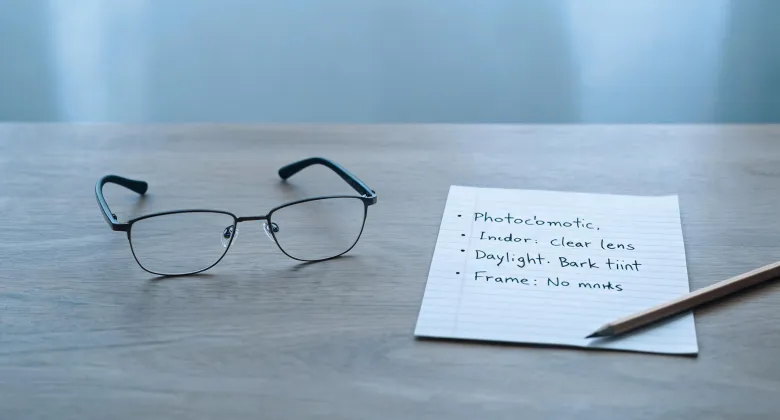
There's No Single "Right Way" to Source Photochromic Glasses
I've been handling photochromic eyewear sourcing orders for about seven years now. In that time I've watched buyers — including myself — waste somewhere north of $18,000 on rework, re-ships, and dead inventory. Most of those losses came from one specific mistake: assuming every photochromic order works the same way.
It doesn't. A cycling order, a rimless frame order, and a non-prescription lens-only order have completely different failure points. The problem is that most sourcing guides treat them as one category. So I'm breaking it down by scenario, because I wish someone had done that for me in 2019.
Before we go further, here's the map:
- Scenario A: Cycling photochromic glasses — performance-driven, active use
- Scenario B: Rimless photochromic glasses — style/optical-driven, fragile-adjacent
- Scenario C: Non-prescription photochromic lenses — volume-driven, spec-light but test-heavy
You probably already know which one you're in. Stick with your scenario section. The last section is a short diagnostic if you're unsure.
Scenario A: Cycling Photochromic Glasses
This is the scenario where people get excited about the photochromic feature and forget everything else that matters on a bike.
Here's the thing — photochromic lenses on a cycling frame live in a brutal environment. Wind, sweat, UV that changes every 40 seconds on a tree-lined descent, and an eyeball 15mm behind the lens. The lens has to transition fast, and it has to transition evenly across its surface.
My first cycling sourcing order in March 2020? I approved a batch of 400 units based on a sample that looked great on my desk. What I didn't test was transition speed under motion. Turned out the lenses took 90+ seconds to go from dark to clear in cooler temperatures. On a descent, that's not a delay — that's a hazard. We ended up selling them as a fixed-tint variant and ate about $2,400 in margin.
What actually matters for cycling photochromic sourcing:
- Transition speed at low temperature. Photochromic molecules slow down in cold. Ask for a transition time spec at 10°C and at 25°C. If the supplier only gives you one number, that's a red flag.
- UV activation coverage. Some cheap photochromic lenses only activate on a narrow UV band. Behind a car windshield with UV filtering — which is where a lot of riders start their ride — they may not darken at all. Ask what UV range triggers the transition.
- Frame shape vs. face coverage. A rimless photochromic lens doesn't help you when wind is blasting your eyes from the side. Cycling frames need wrap coverage, and that changes how the lens is cut.
- Sweat and salt resistance on the coating. This one is boring until it isn't. A coating that fails after 3 months of sweat exposure means returns you didn't budget for.
"Most buyers focus on the photochromic feature and completely miss the transition temperature curve. That single spec has cost me more money than any other thing in this category."
Scenario B: Rimless Photochromic Glasses
Rimless is where I've seen the most preventable damage — and it's not damage to the product. It's damage to the customer's perception of your brand.
Here's why: rimless frames have almost no place to hide a manufacturing defect. The lens edge is exposed. The mounting hardware is visible. The drill holes for the temples sit right at the edge of the lens. Any inconsistency in lens thickness, edge polish, or hole placement is immediately obvious — not to an inspector, to the end customer.
I learned this one the hard way in September 2022. Ordered 600 rimless photochromic units. Samples were fine. Production batch came in with visible edge chipping on maybe 8% of units. Not enough to fail QC on paper. Enough that a distributor's customer would notice. That single issue cost us a 3-week delay and the distributor dropped us for the next two quarters.
What to lock down for rimless photochromic sourcing:
- Minimum lens edge thickness. Photochromic lenses are often made from different base materials than standard lenses. The edge thickness that works for a standard lens can be too thin on a photochromic one, especially at the drill points. Ask for the edge thickness at the thinnest point, not the nominal number.
- Edge polish spec. Not "polished" — ask for the actual finish grade. A rough polish shows every micro-scratch under light.
- Mounting hardware tolerance. If the drill holes are off by more than 0.3mm, the temple won't sit right and the frame will feel loose on the face. Ask for the tolerance spec. If the supplier doesn't have one written down, walk.
- Transition uniformity across the lens. On a rimless frame, the lens is the design. If one corner transitions at a different rate than the center, it's visible. Test this on the sample with a UV light in zones.
Here's the counter-intuitive part: for rimless, I now recommend paying more for a slightly thicker lens and a slower premium polish line. The $1.20 per unit difference disappears when you're not eating a 8% return rate.
Scenario C: Non-Prescription Photochromic Lenses (Lens-Only Orders)
This is the scenario that looks simplest and isn't. No frame, no fitting, no assembly — just lenses. What could go wrong?
A lot. And it usually goes wrong in a way you don't discover until 90 days after delivery, because photochromic performance degrades over time if the manufacturing process was rushed.
In 2021 I placed a 5,000-unit lens-only order with a new supplier. Price was 22% below my existing source. Samples were fine. First container delivered fine. Second container — about 60 days later — started showing uneven fading. Some lenses stayed slightly tinted indoors. Customers noticed. We ended up replacing 1,100 units and I lost that account for 18 months.
The lesson wasn't "don't chase price." The lesson was "test photochromic lenses for fatigue behavior, not just initial performance."
What I now require on non-prescription lens-only orders:
- Cycle testing data. Ask the supplier for accelerated cycle test results — how many dark/clear cycles before the lens shows measurable fatigue. A real number, from a real test. If they can't provide it, that's your answer.
- UV400 blocking as baseline. Per the ANSI Z80.3 framework for non-prescription eyewear, UV400 is the baseline expectation for outdoor use. Get it in writing for every batch, not just the sample.
- Batch-to-batch consistency sample. Ask for a sample from the actually-shipping batch, not the master sample. I know that sounds obvious. I didn't do it for two years.
- Storage and shelf-life spec. Photochromic lenses have a shelf life. If the supplier doesn't know theirs, your inventory planning is a guess.
How to Know Which Scenario You're Actually In
This is the part where most guides tell you to "consider your needs." That's not useful. Here's a more concrete diagnostic.
You're in Scenario A (cycling) if:
- Your end user is moving — road, trail, commute — and the lens has to adapt in motion
- You care about wind protection and retention more than aesthetic
- Your warranty claims historically come from "lens didn't respond fast enough"
You're in Scenario B (rimless) if:
- Your distribution channel is optical retail or premium fashion
- Your returns are more likely to be "looks wrong" than "performs wrong"
- You've ever had a customer comment on edge quality
You're in Scenario C (lens-only) if:
- You're supplying to labs, assemblers, or other eyewear brands
- Your spec sheet is heavy on optical and UV parameters and light on frame detail
- Your main risk is batch consistency over time, not first-sample performance
And if you're in more than one — which a lot of B2B buyers are — don't use one supplier for all three. I tried that once. The tolerances and testing requirements are different enough that a "one-stop" vendor ends up mediocre at all of them.
If you're still unsure, here's the fastest shortcut: look at what your last three customer complaints were about. Whatever those complaints cluster around tells you which scenario you're actually in — regardless of what your purchase order says.