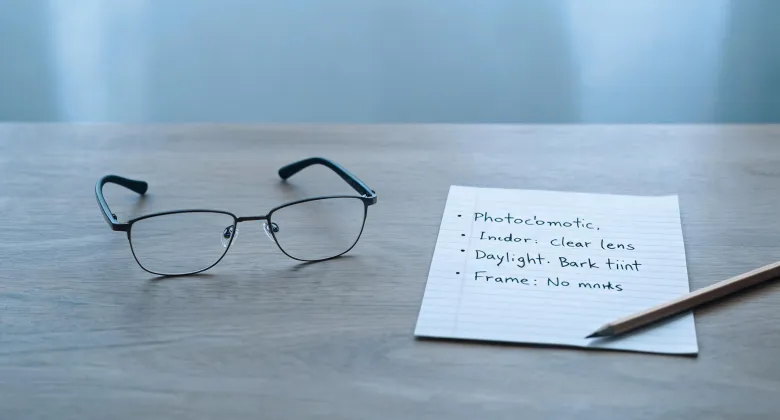
There is no single best way to source photochromic glasses. I've reviewed enough samples to know that the right route depends on your use case, volume, compliance needs, and how much QC you can absorb. I work as a quality and brand compliance manager at an eyewear sourcing company. I review every sample before it reaches customers—roughly 300 SKUs a year. In 2024, I rejected about 18% of first deliveries for issues like slow fade-back, rimless mounting cracks, or coating haze.
So before you ask for quotes, sort yourself into a scenario. Here are the four I see most often.
Scenario A: Cycling and active outdoor programs
For photochromic glasses cycling, the lens isn't the only spec. You're sourcing a system: lens, frame geometry, ventilation, nose pads, and temple grip. The failure mode is usually fog, slow fade-back, or insufficient coverage—not just darkness.
Ask vendors for activation and fade-back data at two temperatures. If I remember correctly, most labs test at 23°C, but riders start at 5°C on early mornings. Cold slows photochromic chemistry. A lens that fades in 60 seconds in the lab may take two minutes on a winter ride. That's a red flag for commuter or road programs.
Counterintuitive take: darker isn't always better. For cycling, prioritize fade-back speed and consistent tint across the visual field over maximum darkening. A Category 3 lens that stays dark under tree cover can feel unsafe. If your riders move between sun and shade, fast fade-back matters more than the darkest state.
Transmittance references matter. ISO 8980-3 covers transmittance properties for ophthalmic lenses. ANSI Z80.3 is the U.S. standard for non-prescription sunglasses and fashion eyewear. EN ISO 12312-1 is the European general-purpose sunglass standard. UV400 means blocking wavelengths up to 400 nm—typically 99–100% UVA and UVB.
For non-prescription cycling, confirm impact resistance and optical clarity. For prescription cycling, keep the Rx and prism specs separate from the photochromic coating. I've seen vendors quote a great photochromic lens, then deliver a frame that can't hold the Rx properly. That's not a lens problem; it's a sourcing problem.
Scenario B: Rimless and fashion non-prescription programs
Rimless photochromic glasses look simple. They are not. The lens edge carries the mounting stress. Drilling, chamfering, and tightening can create micro-cracks that show up after shipping or after a few weeks of wear.
In my first year, I made the classic spec error: I assumed photochromic meant the same thing to every vendor. Cost me a $1,800 rework on a 400-unit rimless run, though I might be misremembering the exact figure. The lenses passed the initial tint check, but 9% cracked at the mounting holes after assembly. We rejected the batch and rewrote the spec to include edge-stress testing.
For non prescription photochromic glasses, especially fashion or event programs, batch-to-batch color consistency is the silent killer. Two gray lenses can be visibly different under the same UV. Ask for a golden sample and a retention sample from every lot. If a vendor says color variation is normal without giving you a tolerance, that's a deal-breaker.
Also check edge thickness and polish. A rimless lens that's too thin at the drill point will chip. A lens that's too thick changes the silhouette. If your brand depends on a clean, minimal look, the cheapest lens is usually the wrong lens.
Scenario C: Private-label OEM and retail programs
This is where sourcing becomes a compliance exercise. You need lot traceability, packaging control, and a QC protocol that survives a retail audit. A blanket claim like FDA or CE certified isn't enough. Ask for test reports tied to the actual lens and frame model.
I don't have hard data on industry-wide photochromic failure rates, but based on our 2024 sample log, my sense is that 10–15% of first articles have some activation, fade, or edge issue. That's a ballpark from our own intake, not a market study.
For OEM photochromic glasses sourcing, build a pre-production sample stage. Review the golden sample under indoor light, full sun, and post-UV fade. Then lock the lens supplier, coating supplier, and frame tooling. If the vendor changes any of those after approval, that's a change-control trigger.
Honest limitation: this route isn't right for every buyer. If your annual volume is under 500 units and you need custom rimless in three colors, a direct factory may not prioritize you. A sourcing partner that consolidates orders can get you better attention, but you'll pay for the flexibility. If you're ordering 50,000 units and have in-house QC, direct factory can work well. The right answer depends on your volume and your ability to absorb risk.
The upside of the cheapest quote is often 10–15% lower unit cost. The risk is inconsistent activation, failed drop tests, or a rework bill that eats the savings. I've watched that trade go wrong more than once. Bottom line: total cost includes rework, returns, and your team's time.
Scenario D: Replacement photochromic lenses and aftermarket
Photochromic glasses lenses are a different sourcing problem. Fit comes first. If the lens doesn't match the frame's base curve, thickness, and mounting geometry, it's 100% waste—no matter how good the photochromic performance is.
Start with the frame. Get the frame trace, base curve, decentration, edge thickness, and mounting type. For rimless or semi-rimless, send physical frames to the lens vendor. If I remember correctly, we once spent two weeks on CAD files before realizing the nose bridge tolerance was the real issue. Physical samples would have caught it in a day.
Counterintuitive take: don't negotiate lens price first. Negotiate the fit guarantee and the remake policy. A $6 lens that fits is cheaper than a $3 lens that creates returns. For aftermarket programs, ask for a fitment sample run before mass production.
Honest limitation: some discontinued frames are not practical to support. If the mount is unusual and the volume is low, replacement lens sourcing may cost more than a new frame program. In that case, say no early. It's better than sitting on 2,000 lenses that don't fit anything.
How to tell which scenario you're in
Use the failure cost to classify yourself. If the main failure is user discomfort or fog, you're in the cycling/active scenario. If it's cracks or returns from aesthetics, you're in rimless/fashion. If it's audits, packaging, or retail compliance, you're in OEM. If it's fit and waste, you're in replacement lenses.
- Volume: Under 500 units? A sourcing partner may be more practical. Over 20,000? Direct factory with your own QC may be better.
- Spec control: Can you write and enforce a lens spec? If not, pay for a partner who can inspect.
- Lead time: Need replenishment in under two weeks? Keep local or regional stock, not direct overseas.
- Compliance: If you sell into retail, ask for transmittance reports, impact test reports, and lot traceability before you pay a deposit.
Three questions will separate real suppliers from traders. Can you provide activation and fade-back curves at 23°C and 5°C? What is your rimless edge-stress protocol? Which standard do you test transmittance to—ISO 8980-3, ANSI Z80.3, or EN ISO 12312-1? If the answers are vague, that's your sign.
I'm not sure why some vendors consistently beat their quoted timelines while others miss. My best guess is internal buffer practices and how they schedule lens coating. What I can say is that the suppliers who answer technical questions with data tend to be the ones who survive a quality audit.
So, which scenario are you? If you're sourcing photochromic glasses for cycling, start with fade-back and ventilation. For rimless, start with edge stress. For OEM, start with compliance and change control. For replacement lenses, start with the frame, not the lens price. Pick the route that matches your failure cost, then build the QC checklist around it.