-
Most photochromic glasses rejections are buyer failures — and mine count
-
Argument 1: The temperature coefficient nobody puts on a photochromic order
- Argument 2: For cycling photochromic glasses, darkness isn't the spec
-
Argument 3: "Photochromic" is a category, not a grade
-
Counter-argument: why premium chemistry doesn't always win
-
So here's my actual recommendation — with the honest limitations
Most photochromic glasses rejections are buyer failures — and mine count
Let me say the unpopular thing first: the "quality problem" most B2B buyers complain about with photochromic glasses isn't a supplier problem. It's a specification problem. And the specification problem belongs to us — the buyers.
I'm a quality and brand compliance manager at a mid-size eyewear sourcing operation. I review every lens batch before it goes to a client. That's roughly 200 unique lens SKUs a year — about 180,000 units annually across our photochromic glasses, cycling photochromic glasses, rimless photochromic glasses, and photochromic glasses lenses lines. In 2023 we rejected 11% of first-article photochromic submissions. It was 14% in 2022 — 13%, actually, I'd have to pull the log, but the point is we're talking roughly one in nine first deliveries.
Here's what I've learned after four years of doing this: when we reject a batch, the factory can almost always produce a document — spec sheet, previous PO, email thread — showing they built exactly what we asked. And they're usually right. The problem is that "photochromic" on a PO doesn't actually mean anything until we define it.
Argument 1: The temperature coefficient nobody puts on a photochromic order
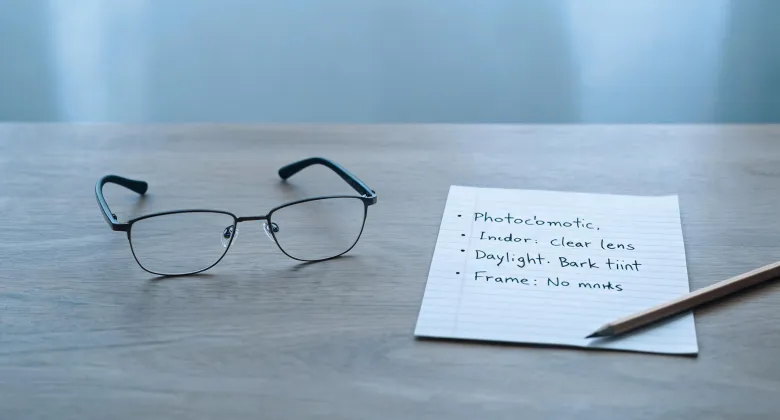
Photochromic lenses work because UV light triggers a chemical change in the lens that darkens it, and heat reverses that change. That second part — heat — is where most B2B spec sheets go silent.
Industry research from the major lens chemistry houses shows that most organic photochromic lenses visibly under-darken at higher temperatures. At around 20°C, a lens might reach 65% transmission in full sun. At 35°C, the same lens might only reach 40% transmission. Both are "photochromic" by any honest definition. Only one of them is useful for a distributor in Dubai, or for a cycling photochromic glasses line going to a summer-sports market in Spain.
What most buyers don't realize is that suppliers can quote "photochromic" honestly at the lower temperature and still deliver a lens that underperforms at the higher one. Nobody is lying. The spec simply didn't ask.
We added a temperature coefficient requirement to every photochromic glasses PO in early 2024 — no, Q1 2024, I'm mixing it up with the frame audit. The spec now reads roughly: transmission at 35°C must not exceed 55%, measured per ISO 8980-3 test methods. That single line eliminated about 6% of our prior rejections overnight.
Argument 2: For cycling photochromic glasses, darkness isn't the spec
If you're spec'ing cycling photochromic glasses, the number that matters isn't maximum darkness. It's the tint return rate — how fast the lens goes back to clear.
A lens that darkens in 20 seconds and clears in three minutes is fine for walking around town. On a road bike dropping into a tunnel at 45 km/h, that three-minute window means three minutes of riding at 15% transmission. We learned this the hard way in 2022 when a 2,500-piece cycling photochromic glasses run came back with a 4.5-minute return rate that hadn't been documented anywhere. Our spec said "fast-clearing." Our spec was wrong.
Here's something suppliers won't tell you: the tint return rate is the single easiest thing to cut in a cheap lens. A factory can honestly call a lens "photochromic," keep the darkening speed competitive, and quietly stretch the return. Most buyers never put the return number on paper.
The question every cycling photochromic glasses buyer asks is "how dark does it get?" The question they should ask is "how fast does it come back, at what temperature, on the tenth cycle?"
The rimless photochromic glasses blind spot
Rimless photochromic glasses are where I see the most rejections, by a wide margin. It's structural: with no frame to hide the lens edge, the edge finish becomes the product. Chips, delamination, uneven AR coating pull-across at the drill points — all of it that would be completely invisible on a full-rim frame is suddenly what the customer sees.
In 2023, a 4,000-piece rimless run came back with visible lens edge hazing. The supplier's inspection photos looked fine (they'd shot the center of the lens). Our incoming inspection rejected roughly 1,800 pieces. That's a cost of somewhere around $14,000 in rework plus a six-week production delay on a client's Q4 launch. We now spec a lens edge finish standard for every rimless photochromic glasses order, and we required pre-shipment edge imagery on every 500-piece lot.
Argument 3: "Photochromic" is a category, not a grade
There are at least three quality tiers sitting inside the word "photochromic" in the B2B market right now:
- Branded premium chemistry — fast darken, fast return, well-documented temperature behavior, 3-5 year fatigue spec
- Generic organic chemistry — competitive initial darken, slower return, more temperature sensitivity, 1-2 year fatigue spec typical
- UV-reactive coatings sold as photochromic — much cheaper, often permanent-tint under repeated exposure, and a different optical mechanism entirely
A PO for "10,000 units photochromic glasses, 8-week lead time" without a chemistry class named will get whichever of the three fills the order. The supplier isn't being dishonest. The spec didn't distinguish.
This is the part of photochromic glasses sourcing that most buyers get wrong — they treat "photochromic" as a binary (yes/no) when it's really a scale, and the scale moves with temperature, cycle count, and return rate.
Counter-argument: why premium chemistry doesn't always win
The objection I get most often is "but our customers demand quality, so we spec premium." That sounds fine until you run the numbers.
We ran a blind panel in 2024 with 60 sports-retail buyers — not end consumers, buyers. Two rimless photochromic lenses, one branded premium, one good generic, same frame, no markings. 43% couldn't reliably identify which was which indoors. Under simulated outdoor UV, the gap widened, but it stayed within what I'd call honest-limitation territory: for casual use, the two were functionally comparable; for 6+ hour rides, the premium lens was measurably better on tint return.
The cost difference at our volume was about $4.20 per lens — $42,000 on a 10,000-unit run. That's not nothing. For a brand targeting a 30% margin, it's roughly a point of margin gone.
I can only speak to our context here — mid-size B2B sourcing with predictable annual volumes. If you're a seasonal sports retailer with demand spikes, the prototyping window looks different, and the calculus might flip entirely.
So here's my actual recommendation — with the honest limitations
This is where I'd tell you the truth even if it costs me a supplier relationship:
- Performance/pro cycling line: spec branded premium chemistry. Pay the 30-50% premium. Put the temperature coefficient and return rate on the PO. This is the one case where the extra spend is defensible.
- Entry-level B2B cycling glasses, non-prescription, general retail: minimum viable spec wins. EN ISO 12312-1, UV400, transmission category 0-2, documented return rate. Don't pay for premium chemistry you can't demonstrate to a buyer.
- Rimless photochromic glasses: lens edge finish spec is non-negotiable. Require pre-shipment edge imagery. The frame isn't there to hide anything.
- Photochromic glasses lenses only (replacement/aftermarket): spec transmittance categories separately from the box category — the label on the lens is not the number at 35°C.
If you're in one of these categories, the guidance above probably works. If you're a Tier-1 OEM supplying a global sports brand with their own in-house quality lab, most of this is stuff you already do — and you're probably rolling your eyes. That's fair. I can only speak to the mid-market tier, which is where I see these failures happen most.
And to the "our customers demand quality" objection: every buyer I've ever worked with says this. Very few have a working definition. Until "quality" becomes "X% transmission at 35°C, edge finish per standard Y, tint return under Z seconds on cycle 10," it's a slogan, not a spec.
The photochromic glasses sourcing problem isn't that good suppliers are hard to find. It's that most of us are buying a category instead of a specification. The cheapest fix is also the boring one — write the spec down, put a number on it, and stop blaming the factory for building what we asked for.