My Unpopular Opinion: Stop Shopping on Unit Price
If you're sourcing photochromic glasses for a team, the lowest per-pair quote is almost always a deferred cost. Not a savings. A deferral.
I manage procurement for a 320-person company. I've bought everything from office chairs to event swag. Photochromic glasses was the first category that made me realize I'd been evaluating quotes wrong for years.
Here's what I mean. When you request quotes for photochromic glasses — whether you're outfitting a cycling team, outdoor field staff, or a corporate wellness program — three suppliers will send back three very different products under the same generic name. And if you sort by price per pair, you will pick the one that has you reordering in six months.
Not ideal. Workable, if you know what to look for. But most buyers don't, because they're evaluating the wrong spec.
Why "Photochromic" Is Not One Specification
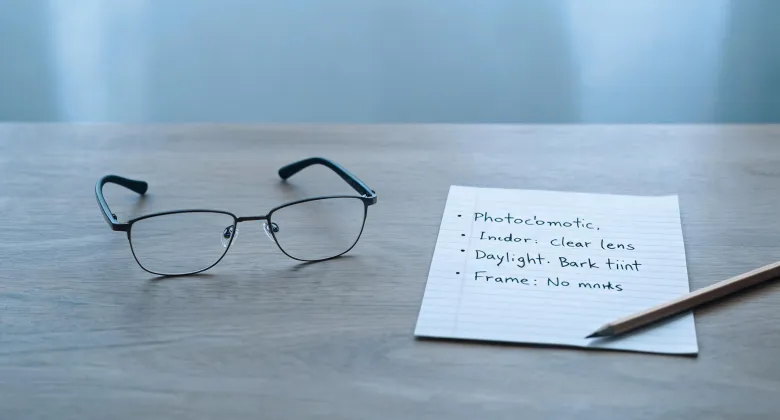
From the outside, photochromic lenses look like one product. Darken in sun, clear indoors. The reality is that "photochromic" covers a spectrum of performance characteristics that are not interchangeable — transition speed, darkness level, temperature tolerance, and UV range.
I'd argue the most overlooked spec is transition speed. Most buyers focus on the per-pair price and completely miss how fast the lens actually darkens. Here's why that matters in practice:
- Cycling photochromic glasses need fast transition — roughly 8 to 40 seconds depending on the lens technology — because riders move in and out of tree cover constantly. A lens that takes 90 seconds to fully darken leaves your cyclists squinting through the open sections. On a road ride, that's not a minor annoyance.
- Rimless photochromic glasses have different UV exposure patterns at the edges, so the lens-to-frame integration matters more than the frame style itself. They're also the category where frame-to-lens gaps are most visible on bright days — the lens does the work, but the mounting decides how consistent the coverage is across the field of view.
- Non-prescription photochromic glasses for team use are a fundamentally different product than prescription versions — and they should be — because the point is interchangeable PPE, not adjustable optics.
The spec sheet is where the money goes. Not the quote.
The Total Cost Trap Nobody Quotes Upfront
When I ran our 2024 vendor consolidation, I found a supplier whose per-pair price was 22% lower than our incumbent. I nearly moved the order. Then I read the fine print: a minimum order quantity of 500 pairs, a $1,200 setup fee for custom frame color, and an "estimated" 45-day delivery from Asia.
Our actual need was 140 pairs. At that volume, the "cheaper" quote was more expensive than the incumbent — and slower.
Here's the checklist I now use for photochromic glasses sourcing:
- Per-pair price at our actual volume, not the MOQ
- Transition speed spec, in seconds
- Temperature tolerance range — photochromic dyes slow down in cold
- Frame style match: cycling wrap vs. rimless vs. standard
- Shipping, duties, and lead time
- Reorder terms and spare-pair availability
That last one has killed more "good deals" than any other factor. Couriers don't care about your savings.
One more thing on quotes: confirm the supplier can issue a proper commercial invoice with a product description that matches what's being shipped. I once had a supplier invoice a $4,200 order as "sporting goods accessories" — no model number, no lens spec. Finance flagged it, and I spent three weeks chasing documentation. Not the worst outcome. Not a good use of a quarter either.
Working with both operations and finance complicates this. Operations wants the spec that holds up in the field. Finance wants the unit price that holds up in the budget meeting. The compromise that actually works is buying the spec you need at the volume you need — which means quoting at your real volume, not the supplier's MOQ. That's why I stopped accepting quotes that weren't priced at our actual order size. The comparison was always skewed.
The Reverse-Intuition Argument: Cheaper Lenses Cost More
This is the argument that surprised me. I assumed cheaper photochromic lenses were just... less premium. They're actually a different chemistry formulation. Lower-concentration photochromic dyes fade back to clear more slowly, darken less fully in heat, and degrade faster with cumulative UV exposure.
Which means a pair of non-prescription photochromic glasses that costs $18 instead of $26 may need replacing twice as often. Over a three-year cycle, that's not a savings. It's a subscription.
Looking back, I should have asked about dye formulation and UV exposure ratings on our first order. At the time, I didn't know to ask. That's the education gap — and it runs both directions. Suppliers who never explain the spec are counting on buyers who never ask.
"Isn't This Just Upselling?"
Fair question. I asked it myself. If a supplier tells you the premium lens is worth it, they have an incentive to say that.
But I'm not arguing you should always buy the premium lens. I'm arguing you should know which spec you're actually paying for. A team that wears photochromic glasses twice a year for corporate events does not need 8-second transition speed. A cycling team training three times a week does.
The cheapest lens for an occasional user is the cheapest lens, full stop. The cheapest lens for a daily-use team is the one that survives the season.
This is where I have mixed feelings about customer education. Part of me wants to hand every buyer a spec checklist and call it done. Another part knows the checklist gets ignored unless you understand why the specifications matter — and the "why" is the part suppliers are least likely to explain unprompted.
What I Actually Recommend
If you're sourcing photochromic glasses for a group, do this before you request quotes:
- Define the use case in writing. Cycling, field work, and event giveaways have different specs. Get it in the brief.
- Ask for transition speed in seconds, not "fast." If a supplier can't give you a number, that's information.
- Request a sample pair at your actual use case. Wear them for a week. Cycling samples should be tested on a bike, not a desk.
- Verify UV ratings against a published standard. EN ISO 12312-1:2022 and ANSI Z87.1-2020 are the relevant ones for eyewear in the EU and US markets respectively. As of May 2026, those are the current published versions — verify any supplier's certification claim against the standard directly, not against the marketing sheet.
- Confirm MOQ, setup fees, and lead time before comparing prices. A quote is meaningless without volume context.
A useful reference point: UV400 is a specification, not a certification. Any supplier claiming "UV400 certified" is using loose language. The protection level is real; the certifying body isn't. This is exactly the kind of thing that will bite you if you're comparing on quote price alone.
Bottom Line
The photochromic glasses category punishes price-first buying. Not because cheap is always bad, but because cheap and wrong are hard to tell apart on a quote sheet.
Pay for the spec you need. Skip the spec you don't. Ask every supplier the same six questions so you're comparing products, not price tags. And remember that your internal stakeholders are reading the same invoice you are — operations cares whether the lens actually works on the ride, finance cares whether the description matches the shipment. A supplier who can explain both spec and cost is worth more than one who can only quote a number.
If you're spending ten minutes comparing unit prices and zero minutes comparing transition speed, temperature tolerance, and reorder terms, you're not buying photochromic glasses. You're buying a pending reorder.
I've made that mistake. The invoice isn't the worst part. The conversation with your operations lead about why the tint is off is.